Introduction
Switzerland’s data center landscape is undergoing a dramatic transformation in 2026. With AI workloads demanding newer infrastructure, stricter environmental regulations, and heightened data security requirements, businesses face a critical question: How do you safely, compliantly, and profitably decommission legacy data center equipment?
For IT managers and data center operators across Zürich, Geneva, and Basel, the stakes have never been higher. A poorly executed decommissioning process can result in data breaches, regulatory fines, environmental violations, and significant financial losses. This comprehensive guide walks you through everything you need to know about data center decommissioning in Switzerland — from compliance requirements to maximizing ROI during AI refresh cycles.
What Is Data Center Decommissioning?
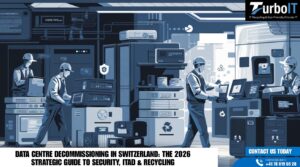
Data center decommissioning is the systematic process of retiring, removing, and disposing of IT infrastructure at the end of its lifecycle. This includes:
- Servers and storage systems
- Network equipment and switches
- Cooling and power infrastructure
- Cabling and rack systems
Unlike simple equipment removal, professional decommissioning encompasses secure data destruction, environmental compliance, asset recovery, and documentation for audit purposes.
Why Data Center Decommissioning Is Critical in Switzerland
Regulatory Compliance
Switzerland maintains some of the world’s strictest data protection and environmental regulations:
- FADP (Federal Act on Data Protection) – Requires secure destruction of all personal data
- GDPR alignment – Cross-border data handling must meet EU standards
- Swiss Environmental Protection Act – Mandates proper e-waste recycling and disposal
Non-compliance can result in fines up to CHF 250,000 for data protection violations alone.
Data Security Risks
Residual data on decommissioned drives represents one of the biggest security vulnerabilities. Studies show that 67% of used hard drives still contain recoverable data when not properly sanitized.
Sustainability & ESG Goals
Swiss corporations face increasing pressure to meet ESG (Environmental, Social, Governance) targets. Proper IT asset disposition Switzerland services ensure:
- Certified e-waste recycling
- Carbon footprint documentation
- Circular economy participation through equipment resale
Step-by-Step Decommissioning Process
Phase 1: Planning & Inventory
- Create complete asset inventory with serial numbers
- Classify equipment by data sensitivity level
- Identify regulatory requirements for each asset type
- Establish timeline and resource allocation
Phase 2: Data Sanitization
- Implement NIST 800-88 or DoD 5220.22-M standards
- Use certified secure data destruction Switzerland methods
- Generate certificates of destruction for audit trails
- Verify destruction through third-party testing
Phase 3: Physical Removal & Logistics
- Coordinate secure transportation with tracked vehicles
- Maintain chain-of-custody documentation
- Ensure insured transit for high-value equipment
- Schedule during minimal business disruption windows
Phase 4: Asset Recovery & Recycling
- Evaluate equipment for resale value
- Partner with certified e-waste recyclers
- Recover maximum ROI through remarketing channels
- Document environmental compliance certificates
Phase 5: Reporting & Documentation
- Compile complete decommissioning report
- Archive certificates for 7+ years (Swiss legal requirement)
- Update asset management systems
- Conduct post-project review for continuous improvement
Key Challenges Businesses Face
| Challenge | Impact | Solution |
|---|---|---|
| Data Security | Breach risk, fines | Certified destruction methods |
| Compliance Complexity | Regulatory violations | Expert partner guidance |
| Downtime Costs | Business disruption | Phased decommissioning approach |
| Asset Recovery | Lost ROI value | Professional remarketing services |
| Environmental Compliance | E-waste violations | Certified recycling partners |
| Documentation | Audit failures | Complete chain-of-custody tracking |
How Turbo IT Solves These Problems
Turbo IT has established itself as Switzerland’s trusted partner for server decommissioning services and IT asset disposition. With deep understanding of Swiss regulations and enterprise-grade security protocols, Turbo IT delivers:
✅ Certified Data Destruction
All data sanitization meets NIST 800-88 standards with verifiable certificates for every asset.
✅ Full Compliance Coverage
Navigate FADP, GDPR, and environmental regulations with expert guidance throughout the process.
✅ Maximum ROI Recovery
Through established resale channels, Turbo IT helps businesses recover 30-60% of original equipment value.
✅ End-to-End Documentation
Complete chain-of-custody tracking from rack to recycling, with archives meeting Swiss legal requirements.
✅ Minimal Business Disruption
Flexible scheduling, phased approaches, and experienced technicians ensure your operations continue smoothly.
Contact Turbo IT at info@turboit.ch or +41 78 619 59 28 for a confidential consultation.
Benefits of Professional Decommissioning Services
Investing in professional data center migration services Switzerland providers delivers measurable advantages:
- Risk Mitigation – Eliminate data breach liability through certified destruction
- Cost Recovery – Generate revenue from retired equipment instead of paying disposal fees
- Compliance Assurance – Meet all Swiss and EU regulatory requirements
- Environmental Responsibility – Achieve ESG goals with certified recycling
- Resource Optimization – Free internal IT teams to focus on core business initiatives
- Audit Readiness – Maintain complete documentation for regulatory inspections
Cost Factors in Switzerland
Understanding the total cost of decommissioning helps businesses budget effectively:
Direct Costs
- Labor and technician time
- Transportation and logistics
- Data destruction certification
- Recycling and disposal fees
Recovery Opportunities
- Equipment resale value (servers, switches, storage)
- Component harvesting for parts
- Precious metal recovery from circuit boards
Hidden Costs to Avoid
- Regulatory fines for non-compliance
- Data breach remediation expenses
- Environmental violation penalties
- Business disruption during poorly planned removal
Pro Tip: Professional services often pay for themselves through asset recovery, turning a cost center into a revenue generator.
Best Practices & Compliance (GDPR, Swiss Regulations)
Data Protection Requirements
- Document all data-bearing assets before removal
- Use certified destruction methods with verifiable results
- Maintain destruction certificates for minimum 7 years
- Verify third-party vendors hold appropriate certifications
Environmental Compliance
- Partner with certified e-waste recyclers (ISO 14001, R2, e-Stewards)
- Track all materials through complete recycling chain
- Obtain environmental certificates for ESG reporting
- Avoid landfill disposal of any electronic components
Security Best Practices
- Implement chain-of-custody documentation throughout
- Use GPS-tracked transportation for all equipment movement
- Conduct background checks on all handling personnel
- Maintain insurance coverage for full replacement value
FAQ Section
What is the average cost of data center decommissioning in Switzerland?
Costs vary by scale, but typical projects range from CHF 15,000 to CHF 200,000+. However, asset recovery can offset 30-60% of expenses through equipment resale.
How long does data center decommissioning take?
Small deployments: 1-2 weeks. Medium facilities: 2-4 weeks. Large enterprise data centers: 6-12 weeks depending on complexity and phasing requirements.
What certifications should a Swiss ITAD provider have?
Look for ISO 27001 (information security), ISO 14001 (environmental), R2 or e-Stewards (e-waste), and documented FADP/GDPR compliance procedures.
Can decommissioned servers be resold legally?
Yes, after certified data destruction. All data-bearing components must be sanitized according to NIST 800-88 standards before resale.
What happens if data is breached during decommissioning?
Under Swiss FADP, organizations face fines up to CHF 250,000 plus reputational damage. This makes certified providers essential for risk mitigation.
Do I need to keep decommissioning documentation?
Yes. Swiss law requires retention of data destruction and disposal certificates for minimum 7 years for audit and compliance purposes.
How does AI refresh cycling affect decommissioning timelines?
AI workloads require newer GPU-enabled infrastructure, accelerating 3-4 year refresh cycles versus traditional 5-7 year server lifecycles.
Conclusion: Your Next Step Toward Compliant, Profitable Decommissioning
The data center decommissioning in Switzerland landscape demands expertise, precision, and trusted partnerships. As AI refresh cycles accelerate and regulations tighten, businesses cannot afford amateur approaches to retiring critical infrastructure.
Key Takeaways:
- Compliance is non-negotiable under Swiss FADP and GDPR
- Professional services maximize ROI through asset recovery
- Documentation protects against future audits and liability
- Certified partners eliminate security and environmental risks
Ready to transform your decommissioning project from a cost center into a strategic advantage? Turbo IT stands ready to guide your organization through every phase with Swiss precision, certified security, and maximum value recovery.
📞 Contact Turbo IT today:
- Phone: +41 78 619 59 28
- Email: info@turboit.ch
- Website: turboit.ch
Secure your data. Maximize your ROI. Stay compliant. The 2026 decommissioning standard starts here.